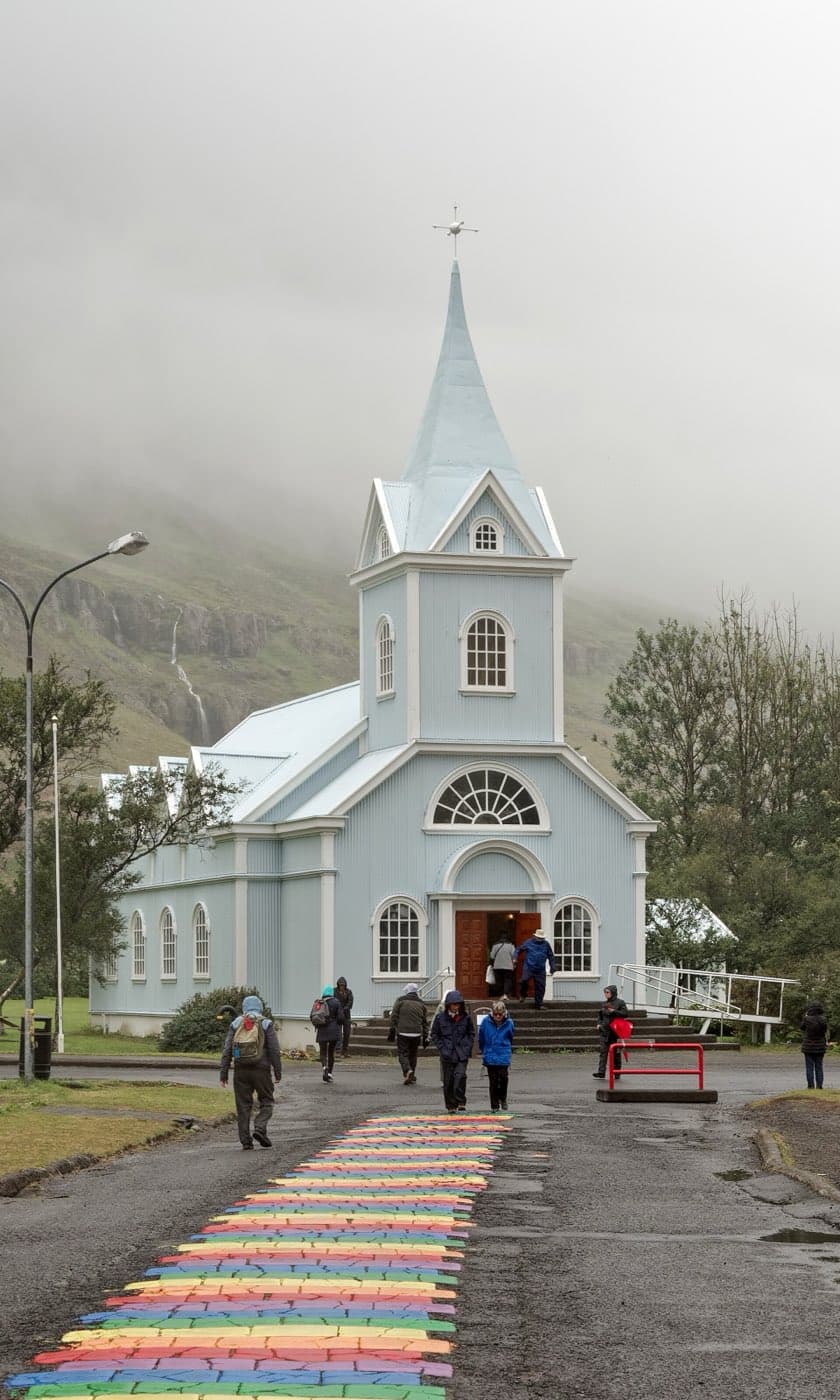
Breiddalsvik is a tiny village in the East Fjords of Iceland, on the shore of a broad bay at Breiddalur. It is a relatively young fishing village, with black sand beaches, seascapes, and an old harbour where fishing and boat tours run. Its name translates as broad-valley-bay, which matches the setting.
The village and the valley behind it
The village sits on the coast at Breiddalur, the longest and widest of the valleys in East Iceland and the broadest valley in the Eastfjords. Mountains rise on both sides of the valley, which gives the bay and shoreline a clear frame.
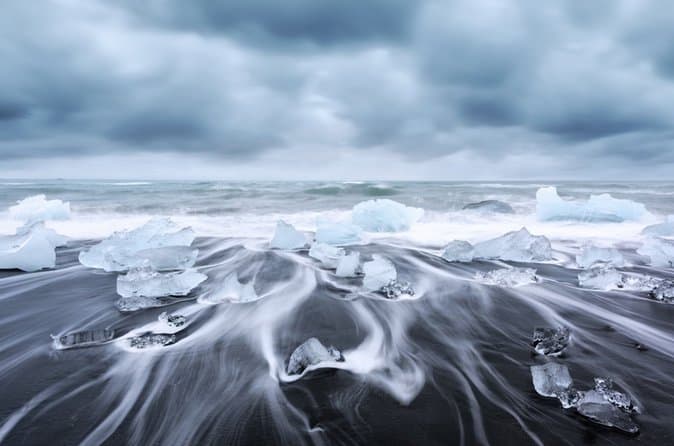
Around the coast, the setting includes black sand beaches and open seascapes. From the old harbour, fishing and boat tours run.
Further into the valley, there are hiking options and places to explore, including Beljandi, Flogufoss, and the Streitishvarf lighthouse.
Inside an eroded central volcano
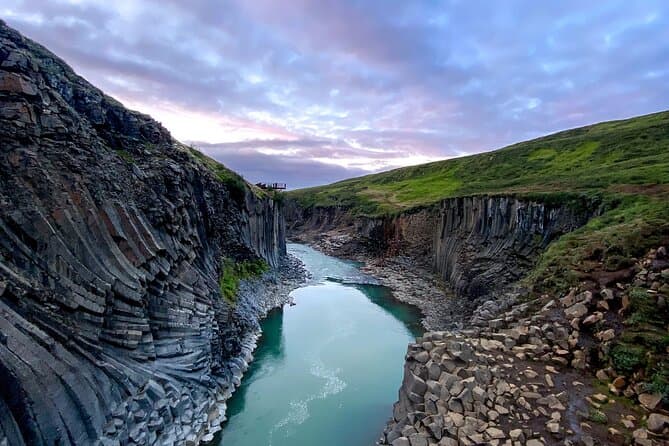
The village sits inside the eroded magma chamber of an ancient volcano and is enveloped by mountains of basalt strata. Above the valley and Berufjordur lies the Breiddalur central volcano, an ancient volcanic area whose eastern side is highly eroded.
The site extends between Mt Fossarfjall, south of Berufjordur, and Mt Baejartindur, above the farm Thorgrimsstadir in Breiddalur. The mountain range separating Breiddalur and Berufjordur contains rhyolite intrusions, including Mt Flogutindur, Mt Smatindar, Mt Rondolfur, Mt Slottur and Mt Stong.
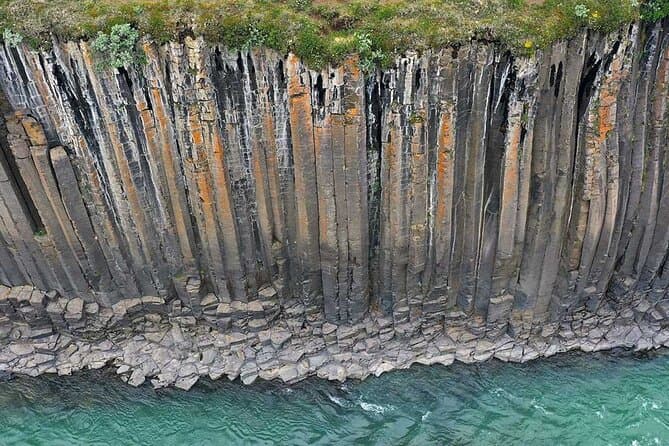
That chain formed as rhyolite worked its way to the surface through basalt layers, creating insertions on top of massive tephra layers along the crater edges. Remnants of that process are still visible in rhyolite rocks across the region.
In the southern part of Breiddalur, near the centre of the area, heat altered the rock so strongly that basalt and andesite turned pale green, making them hard to distinguish from rhyolite. This is visible at the Blagil ravine on the river Innri-Ljosa.
The Breiddalur central volcano is considered to be of a later date than the Alftafjordur and Reydarfjordur central volcanoes.
Minerals underfoot, and the rules about taking them
Colourful rocks and minerals are found at every footstep around the village. The area’s volcanism has produced a wide variety of rare minerals and semi-precious stones.
Most of the known localities for decorative stones in Iceland are in the Eastfjords. At the same time, Icelandic nature conservation law places a general duty of care on everyone to treat the country’s nature well and take the utmost care not to spoil it.
Taking objects from Icelandic nature, such as ornamental stones, out of the country without permission from the Icelandic Institute of Natural History is not allowed. Within protected areas, it is strictly prohibited to disturb or remove geological formations.
Mapping East Iceland's ancient volcanoes
Breiddalssetur is in the Old Cooperative Merchant House in the village. It facilitates earth and literary research activity focused on East Iceland and holds exhibitions on regional geology, linguistics and local history.
Among the material preserved there are notebooks, diaries and photographs from George P. L. Walker, who lived from 1926 to 2005. He was a British geologist and one of the most prominent volcanologists of the twentieth century. He mapped the geology of east Iceland, and the Tertiary volcanology of East Iceland was the main object of his professional work.
Fitting the village into a drive
As an alternative to the Ring Road, Route 95 runs through Breiddalur and then climbs over Breiddalsheidi, which is itself an ancient, eroded volcano. Route 95 ends at Egilsstadir.
Driving times between places in Iceland can be compared with the Driving Distance Calculator.
Comparing East Iceland tours
East Iceland tours can be compared side by side.