Driving in Iceland mostly means the Ring Road, Route 1, a loop of more than 1,300 km that is fully paved and circles the island. On the open road the limit is 90 km/h, dropping to 50 km/h in built-up areas, and single-lane bridges are common. The highland F-roads are a different matter: unpaved, often with river crossings, open only in summer, and legally requiring a 4x4.
Driving in Iceland at a glance
| Driving in Iceland | |
|---|---|
| Main route | Ring Road (Route 1), more than 1,300 km |
| Surface | fully paved |
| Open-road limit | 90 km/h |
| Built-up areas | 50 km/h |
| Gravel roads | 80 km/h |
| F-roads | 4x4 required, summer only |
The Ring Road and road surfaces
Route 1 loops more than 1,300 km around Iceland and is fully paved, so a standard 2WD car handles it in summer. Most people take 7 to 10 days to drive the full circle with sightseeing stops, and rushing it in fewer leaves little room for weather. Once you leave Route 1 and the main paved roads, surfaces often turn to gravel, which behaves differently, with loose edges, washboard corrugations, and dust that cuts visibility.
Speed limits and single-lane bridges
Speed limits are generally 50 km/h in built-up areas, 80 km/h on gravel roads, and 90 km/h on paved rural roads, with lower limits where signed. Single-lane bridges, marked einbreið brú, are common on Route 1, and the first vehicle to reach the bridge has priority, so slow down early and be ready to give way. Watch also for blind rises, marked blindhæð, and for sheep near the road. Headlights stay on day and night, seatbelts are required for everyone, and off-road driving is illegal.
F-roads and when you need a 4x4
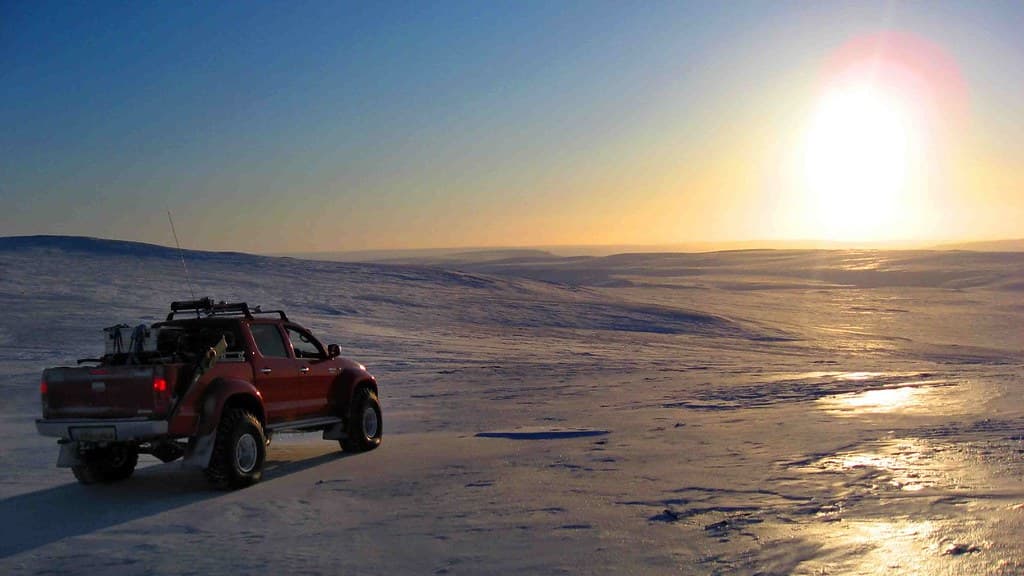
F-roads are mountain roads, marked with an F before the number, and they are not part of the Ring Road. Well-known examples include the Kjölur (F35) and Sprengisandur (F26) routes across the highlands. They are unpaved, frequently include unbridged river crossings, and are open only in summer, roughly from late June into autumn depending on the year and conditions. A 4x4 is legally required on them, 2WD cars are not allowed, and rental insurance will not cover a 2WD car driven there. Never enter a river crossing you cannot read, and turn back if conditions look beyond your vehicle or experience.
Winter driving and checking conditions
Winter driving adds ice, packed snow, strong crosswinds, and short daylight, and conditions can differ sharply from one region to the next. Winter tyres are standard in the cold months, and storms can close roads with little warning. Before and during any trip, check road.is for road conditions from the Icelandic Road and Coastal Administration, vedur.is for the Icelandic Met Office forecast and wind, and safetravel.is to leave a travel plan and read current alerts. If you would rather not drive the coast in winter, you can compare guided South Coast tours instead.
Plan for refuelling
Current Iceland gas prices can help you set a realistic fuel budget before a long drive. The petrol station finder maps every station recorded in the country, sorted by distance from where you are, so you can see where the long gaps fall before you set off rather than after.