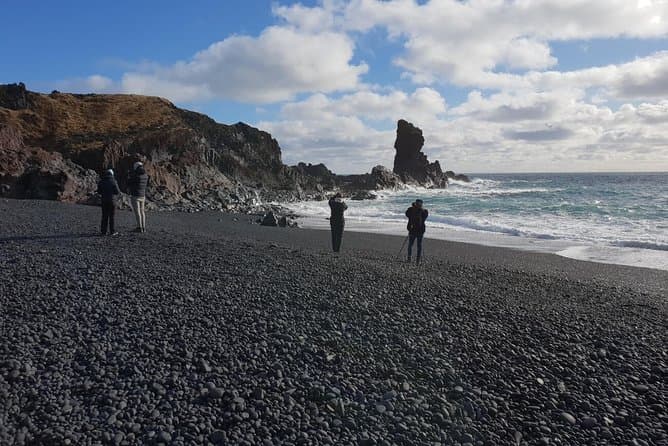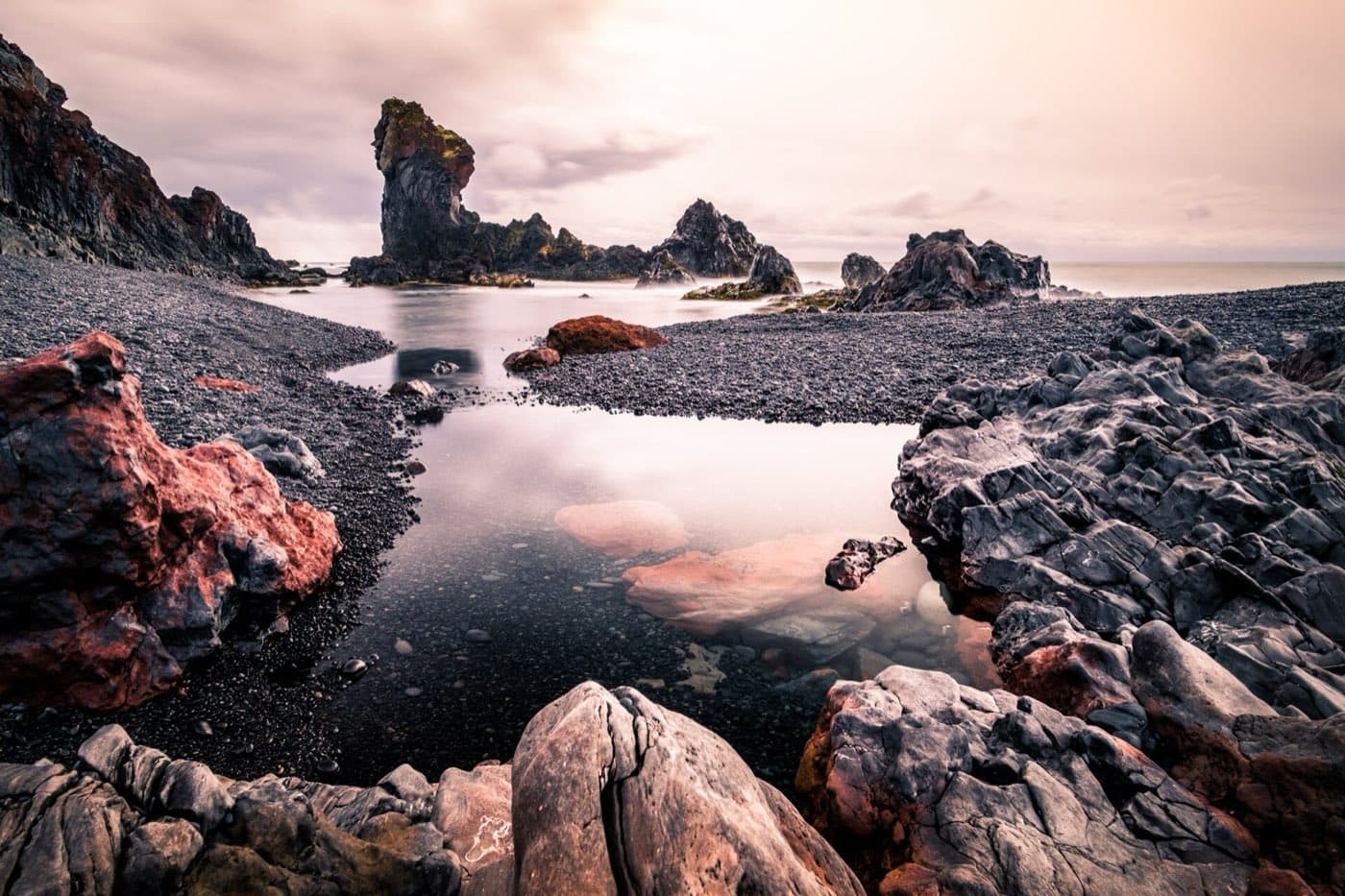
Djúpalónssandur is a black pebble beach on the south coast of the Snæfellsnes peninsula, inside Snæfellsjökull National Park and about 200 kilometres from Reykjavik. It is known for four old lifting stones that fishermen once used to test their strength, and for the rusted wreckage of the British trawler Epine, which ran aground here on 13 March 1948 with the loss of fourteen crew. This guide covers where the beach is, its black pebbles, the lifting stones, the shipwreck, and how to visit safely.
Djúpalónssandur at a glance
The essentials before you go.
| Feature | Detail |
|---|---|
| Location | South coast of the Snæfellsnes peninsula, West Iceland |
| Within | Snæfellsjökull National Park |
| From Reykjavik | About 200 km, roughly two and a half hours |
| Known for | Black pebbles, four lifting stones, a 1948 shipwreck |
| Nearby | Dritvík cove, a short walk on |
| Access | Footpath down through lava rock |
Where the beach is and getting there
Djúpalónssandur lies on the southern shore of the Snæfellsnes peninsula in West Iceland, within Snæfellsjökull National Park and close to the foot of the Snæfellsjökull volcano. It is about 200 kilometres from Reykjavik, roughly two and a half hours by road on Route 1, the Ring Road, and then Route 54 out along the peninsula. From the car park a footpath drops down through weathered lava toward the shore, passing tall rock pillars and small lagoons behind the beach. The path is short but uneven, so sturdy shoes help.
The black pebbles
The beach is not sand but a bed of smooth black pebbles, rounded over a long time by the surf. Locally they are called Djúpulónsperlur, the pearls of Djúpalón. They are part of the protected national park, so visitors are asked to leave them where they are rather than take them home. The pebbles run right down to a shoreline where the Atlantic breaks hard against the coast.
The four lifting stones
Set on the beach are four large stones that were used to test the strength of men seeking work on the fishing boats that once launched from here and from nearby Dritvík. From lightest to heaviest they are Amlóði at 23 kilograms, Hálfdrættingur at 54 kilograms, Hálfsterkur at 100 kilograms, and Fullsterkur at 154 kilograms, their names running from useless up to fully strong. The old rule was that a man had to lift at least Hálfdrættingur, the 54-kilogram stone, onto a ledge to be taken on as a crew member. The stones are still there, and visitors often try their own strength against them.
The 1948 Epine shipwreck
Scattered across the pebbles toward the water are pieces of rusted iron from the Epine, a British trawler from Grimsby that ran aground at Djúpalónssandur on 13 March 1948. Fourteen of the crew died in the wreck. The twisted metal has been left where it lies as a memorial to the men who were lost, and it is protected, so like the pebbles it should not be moved or carried off. The remains are easy to mistake for ordinary beach debris, so it is worth knowing what you are looking at.
Safety and visiting nearby Dritvík
Djúpalónssandur faces the open Atlantic, and the surf here is powerful and unpredictable, with sudden surges that can run far up the beach. Keep well back from the water, never turn your back on the waves, and watch children closely, since the safetravel.is advice for exposed south-coast beaches applies here too. A short walk west leads to Dritvík, a sheltered cove that was one of Iceland's busier fishing stations in earlier centuries. The beach fits naturally into a day around Snæfellsjökull National Park, either self-driven or on a guided trip that handles the long drive from the capital, so it is worth comparing current Snæfellsnes tours to weigh the options.
Map the drive
Use the Driving Distance Calculator to see how Djúpalónssandur beach fits with the other places on your route.